Category: Word on the Street

  • Love Your Neighbor

    For 73 days this year, Virginians sheltered in place under the Governor’s “stay at home” order. But the reality for 110 neighbors within the Micah community was that they had no shelter in which to place. 

    Through the love of our churches, Micah committed to remaining a lighthouse in the storm – to securing emergency, socially-distanced motel rooms for our vulnerable neighbors. We committed to keeping the doors of Micah Hospitality Center open for showers, clean clothes, and other basic provisions. We delivered thousands of hot meals, expedited transitions into permanent housing (51 and counting), and worked with many of our neighbors to increase their income. We distributed cleaning supplies, masks, and hand sanitizers. We showed up, even if that meant gathering in a parking lot six feet apart.

    Our prayer remained, if only for a season, to get everyone off the street. Today, our prayer is that no one has to return to the street. That all of our guests continue to experience the security and stability of shelter, and eventually a permanent home. That our guests don’t just survive. That they thrive.

    Yet the future remains unknown, and in many ways, our challenges are only just beginning. Here are some ways you can make an impact. 

    $15 provides a night of winter shelter for one person

    $25 buys a tent or sleeping bag

    $30 keeps someone in housing for day

    $45 keeps someone in a socially distanced shelter bed for a night

    $100 buys a night of respite care for a person recovering from a hospital visit

    $200 a day sparks the spiritual walk of new disciples

    $350 a day provides basic needs of people living on the street

    $900 covers the average rental deposit

    $1500 bridges a someone to work

  • Neighbors in the Shadows of ALICE

    There has been much talk in recent years about the ALICE (Asset-limited, income-constrained, employed) population. In a different time, ALICE would be considered the working poor. 

    While we hope you will read the 2020 Virginia ALICE report and consider its implications on people living in  our own community, don’t miss the peripheral perspective of those whose story is not being told in these numbers. 

    ALICE represents those in our community who earn more than the federal poverty level, but less than the basic cost of living. Often, they work in essential positions with wages far below the basic cost of living. 

    According to the ALICE report, approximately 39% of Virginians struggle to make ends meet. Generally, the portion considered part of the ALICE population is the 29% living above the federal poverty level ($12,760 for a single adults and $26,200 for a family of four). Another 10% live below that threshold. 

    While the struggles of the ALICE population do at times result in homelessness, it is true that most in the statistically defined ALICE group remain safely out of shelters and off the street. For instance, 14% of those seeking Micah’s assistance in the last twelve months reported income above poverty–qualifying them as ALICE.

    Although most of our homeless population does live below the federal poverty line, 24% of those seeking Micah’s help last year did have income. Here are some examples of tour neighbor’s unique struggles:

    • People who become homeless have often worked their entire lives but a divorce, a disabling accident, mental breakdown, lay-off, catastrophic event sent them spiraling. 

    • They are children of parents who have been an ALICE; Or they have grown up in poverty or foster care and do not know what it’s like to live outside of survivability. Sometimes they are still recovering from the trauma of not having a present adult and the unintended consequences of the choices their families had to make to survive.

    • Many times the mental or physical disability that brought someone to the street has come after years of a decent wage. Even with a work history and the right support, a social security application can take up to a year or more to process.  Savings and retirement are depleted quickly when functioning at less than work life capacity and family relationships are strained. The average social security recipient earns between $800 and $1258 a month.

    • Some wake up every morning at 4amjust to make it to a day labor site for a limited job ticket. They beat up concrete, stand for hours in the blazing sun and bone-chilling cold and eagerly jump into the jobs that regular contractors don’t want to do, just to bring home $50. It’s often enough to get a bite to eat, rent a hotel room, pocket a couple dollars, and do over again the next day. 

    • A person working full time at minimum wage ($7.25 an hour) earns $15,080 a year. Most employers with low end jobs, however, don’t offer more than 29 hours because they would have to pay health insurance. That’s $10,933.

    • Plenty of people get second and third jobs to survive. And as the ALICE report will affirm, this is at great cost to their social, emotional and financial well-being. But as much as some people may want to work multiple jobs, personal limitations and the daily worry of where they will sleep, get a meal and tend to other basic needs makes it a win for them to hang onto one. 

    • Many of of our homeless neighbors are trying to get a job, but no one will take a chance on them because of their background, educational limitations or disabilities. 

    • When they do get a job, they are haunted for years by overdue debt and garnishmentsscraped right off the top of their paycheck. Some people can literally work a 40-hour-shift and walk out with nothing because their entire check is catching up with old obligations.

    • So brutal is the struggle to get and keep a job in the midst of homelessness that many people give up and even begin to believe they are not worthy of having one. 

    It doesn’t take much for the human spirt to simply give up. 

    Author and Pastor Rob Bell says, “Despair is believing that tomorrow is going to be the same as today.”

    If they do not already hold a job, most people who are homeless or living in poverty want to work, have purpose and a dignified income. For whatever reason, they fell through the cracks of whatever safety nets were in place and their circumstances left them with little reason to think tomorrow will ever come. 


    But if we want our homeless neighbors to be an ALICE or even rise above it, we have to talk about them too. 


    They are without question asset limited, income constrained and desperately desiring, if they do not already have, a dignified income. But far too often there are external factors standing in the way, including their own belief that their lives can have meaning and purpose, as well. 

    Please take the time to read and reflect upon the ALICE report, but we ask that you do so with a comprehensive picture of poverty. 

    If we truly care about ALICE, our advocacy will not stop short on whether our neighbors are working enough or deserving enough of time and resources. We will consider all the factors that put people at risk and how we can care for them better when they fall through the cracks.   We will look at living wages, systemic racism, hurdles of the criminal justice system, debt collection and lending practices, affordable housing, access to health care, the stigma of mental health, food security,  transportation, access to technology and the profound catastrophic breakdown in how we love our neighbors—all of them.

  • Word on the Street: Persistent Curiosity

    In the summer of 2017, a speaker at the National Alliance to End Homelessness Conference presented a video on how a systemic response to homelessness should work.

    The video portrayed a drawing of a waterfall, representing all the people falling into homelessness. As the tape rolled, the artist erased parts of the waterfall and gradually replaced it with buckets. Each bucket represented different kinds of service providers. Some focused on families, while others were more prepared for singles or special segments of the population.

    One by one, the artist lined up street outreach programs, shelters, prevention efforts and housing initiatives, essentially making the point that all parts of a homeless service system working together would stop the water (people) from trickling into the ravine (homelessness).

    While the message of ending homelessness resonated deeply with everything I hoped and wanted to believe, the efficiency and simplicity of the model seemed far too perfect for the imperfect human lives that often face housing crisis.

    Something was missing.

    In full disclosure, I’ve led countless webinars and workshops of my own on the vision of ending homelessness. Some communities have even been crazy enough to invite me as consultant in their work to replicate the best practices increasingly touted by funders and advocates across the country.

    But always, when I return to the day-to-day work of loving and living in relationship with our neighbors, I find myself tormented by the harsh truth of a need that far surpasses the best of systemic interventions.

    After 15 years, I am still amazed at what happens when a person who could not succeed in any other program is given a set of keys and placed in the care of relational case managers.

    Yet, I am increasingly troubled when the same four walls that keep some frequent flyers out of jail and limit their hospital visits bring about an isolation, a disconnection and a deterioration beyond anything others would have experienced on the street. The grief never grows cold when those who survived the unthinkable on the streets, are found dead and alone after just a few short months in a new apartment. These are the burdens that occupy my thoughts in the darkest hours of the night.

    For all the progress in moving people off the street, building sustainability and ending homelessness, there remains a silent struggle for connection, belonging and community.

    To think that homelessness could someday cease to be a societal ill would be the most miraculous of miracles in the hearts of many. But claiming that systems alone will heal our world from a plague of displacement that has haunted the human story since the beginning of time places the power of divine phenomenon in the palm of creation rather than the hand of God.https://c36bb4cbb6a51434ec247bea968369d0.safeframe.googlesyndication.com/safeframe/1-0-37/html/container.html

    So, too, is the holy spirit limited when humanity claims that some problems are too big to solve and some people are too complex to help.

    Thomas was one such child of God who approached the miraculous with logic, reason and data. His fellow disciples had seen the risen Lord in John 20:24-29, and yet he would not believe until he could literally touch the wounds Christ garnered on the cross.

    On one hand, Thomas is far too systemic in his approach to the resurrection. Jesus even comments on his inability to believe in the miracle despite a visual assessment of the situation. “Blessed are those who have not seen and yet come to believe,” Jesus says.

    On the other hand, we can applaud Thomas for being the only disciple brave enough to lean into the discomfort of what had actually just occurred. He had enough curiosity about social ills that had led to the crucifixion to reach out and touch that which made the miracle fundamentally real.

    Many a miracle in Jesus’ time stemmed from a similarly persistent curiosity. Visualize the Canaanite woman insisting the disciples allow her an audience with Jesus, willing to accept nothing more than crumbs to heal her demon-possessed daughter (Matthew 15:21-28). Picture the bleeding woman, seemingly unworthy of public appearance for more than a decade, sneaking through the crowd just to find her healing in the hem of Jesus’ garment (Luke 8:43-48).https://c36bb4cbb6a51434ec247bea968369d0.safeframe.googlesyndication.com/safeframe/1-0-37/html/container.htmlhttps://c36bb4cbb6a51434ec247bea968369d0.safeframe.googlesyndication.com/safeframe/1-0-37/html/container.html

    Perhaps, the miracles we desire in our world today are less about what we can actually do to inspire them and more about leaning into the discomfort of things we do not understand. Maybe, just maybe, our call to cultivate and care for creation doesn’t actually require us to fix anything, but to reach far into the places unknown and trust that even the smallest brush with the cloak of Christ will make us all well.

    Might we have the curiosity of Thomas, the persistence of the Caananite and the faith of the bleeding woman to stick our finger deep into the wound of the world and believe, even when we cannot see it or explain it, that the miracle will occur.

  • Sustaining Hospitality

    Sustaining Hospitality

    Covid-19 has changed the way the world looks at hospitality. We protect others by being less inclusive – we don’t gather with our friends and family, we don’t share as freely, we keep a distance and often a barrier between ourselves and those we meet. While Micah is not exempt from these new social norms, five months into the pandemic we are still pursuing hospitality in the most creative ways we can. 

     
    When it became clear that this virus was a real threat and it would be necessary for anything ‘non-essential’ in the community to close down, Micah committed to be the lighthouse in the storm.  Most of us could distance ourselves from CoVid-19 by sheltering in our homes. Besides the enhanced risk of infection that comes from living outdoors, suddenly our homeless population would not have the same access to community meals,  temporary shelter from the elements, or even public bathrooms and water sources they had relied on for basic safety. They needed the Hospitality Center on Princess Anne Street to remain open as a starting point and source of community in circumstances that were far more complex in the midst of pandemic.  

    Although we’ve had to do some things differently, the center is still welcoming people Monday through Friday from 9am to 1pm. Thankfully, emergency management resources have made it possible for nearly all of our street homeless to be offered temporary shelter. We cannot imagine the crises that would be before us, had that opportunity come to fruition. For them, hospitality can now be delivered one on one. It comes directly to their doorstep in ways we have only dreamt about.  But everyday that we open the doors to a heat index of 100 plus degrees or a severe storm warning, we remember that there are some whose circumstances prevent them from accepting help and new people lose their homes every day.  


    There are things the Hospitality Center still can’t provide. We can’t provide a whole morning’s refuge from the elements. We can’t gather for a mini health clinic or food distribution. We can’t provide that much needed haircut or the perpetual flow of coffee. We require masks and social distancing and limit the number of people at any given time. Lunches are take out only. And our guests these days often have to access community resources through a computer screen. But, if nothing else, we can provide a place to come inside for a few moments and make a connection.
     
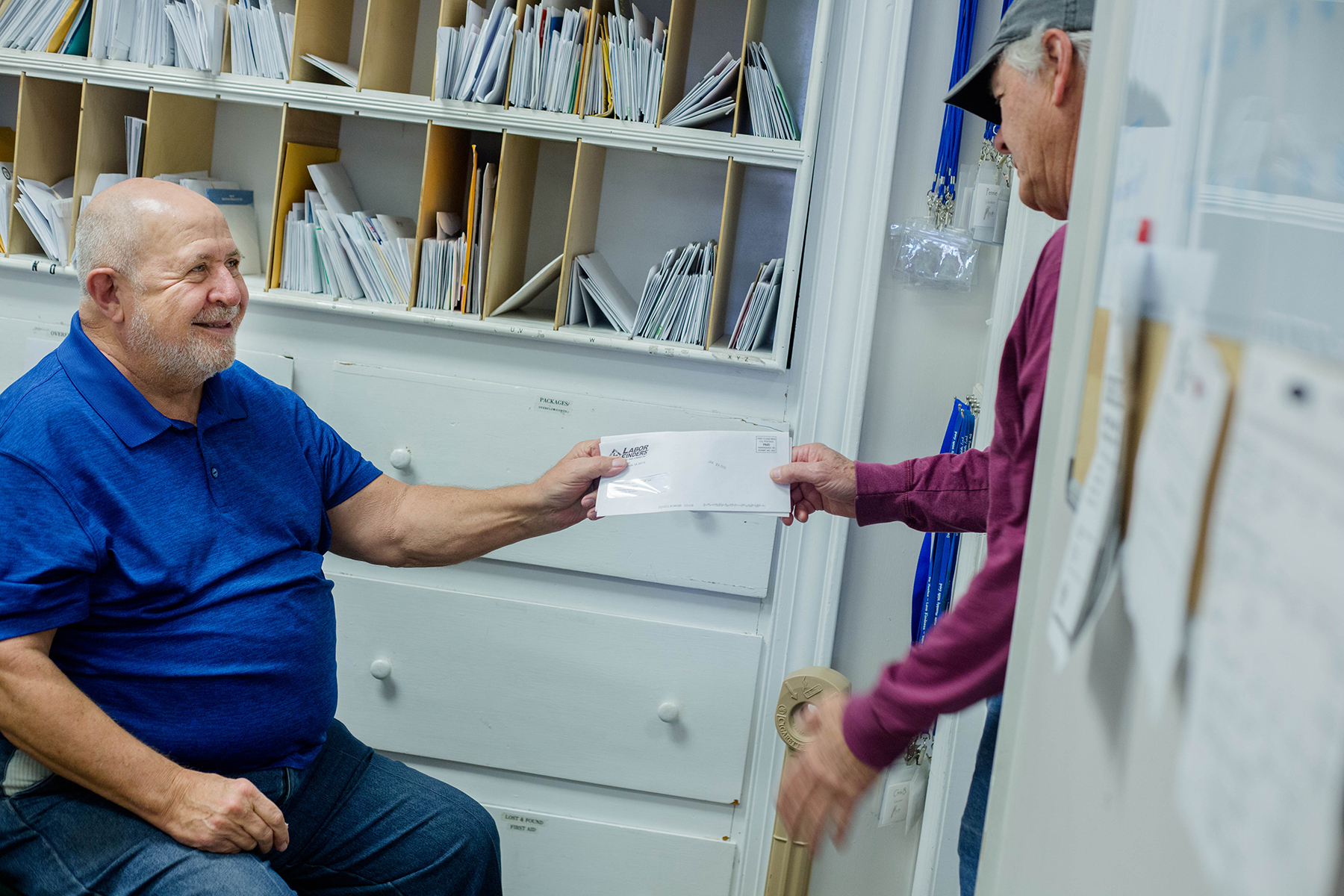
    That connection might be a shower that allows someone to feel clean again after a couple of nights sleeping outside. It can be an address where the post office can leave the envelope that contains connection to family, benefits or other important information. It is connecting with someone to help you figure out how to replace the lost identification card or sort out complex paperwork. It’s a bag lunch when you haven’t eaten yet or a few extra bottles of water when the low temperature is in the 80’s. It’s someone to welcome you inside, even if only for a short time, and ask you what has happened since the last time you were here.

    The hospitality center is a care coordination hub for those who sleep on the street. Although the direct traffic coming through 1013 Princess Anne St. is currently smaller, we are providing the same care we always have in the places people are sheltering. Due to CoVid-19, some of our volunteers have dwindled and there are many ways you can help be a part of the unique ways we are caring for people in this season. 

    For more information on the hospitality center:

    Margie Zambon-Brewer

    Hospitality Navigator

    (540) 479-4116 x15

    [email protected]

  • A Place for All to Shelter

    A Place for All to Shelter

    Homelessness could look quite different in the Fredericksburg Region in the next few months. 

          A large flow of CoVid-19 relief funds has equipped local homeless service providers with the resources to stabilize most of the current homeless population in permanent housing. 

          This does not mean that homelessness will become non-existent, but the state funding announcement issued Friday will help move approximately 95 households in a short amount of time.  
          Since 2008, the Fredericksburg Regional Continuum of Care has been housing people out of shelters and off the street using a model called rapid re-housing. Rapid re-housing means finding an available apartment and proving financial assistance and case management until the household can reach independence. A shared housing locator helps find units on behalf of Micah, Hope House, Empowerhouse and Thurman Brisben. 

           With the volume of resources historically available to Fredericksburg service providers, our community moves an average of 78 households per year from homelessness to permanent housing. This approach has a demonstrated success rate of 81% not returning to homelessness within two years of exiting the program. 

           While the latest infusion of resources will allow our community to serve more people, there is concern among homeless service providers that we will not be able to find enough units to move everyone quickly enough. 

          Many of the units in the target price range ($1100 or less) and owned by landlords with a tolerance for the unique needs of the homeless population are still full with many of the people our community has housed over the years. This speaks to the huge success of housing efforts in our community, but it doesn’t give us a lot of answers in finding new units in a short period of time. We need new landlords and housing options to place homeless households in the next several months. 

          If our community can move people out of homelessness as quickly as we are now resourced to do so, it will be an incredible win for those experiencing housing crisis; and our region will be an example across the state and possibly the country of how a community can care for its neighbors.

         If you are a landlord or know someone who is, please consider connecting them with our housing locator to discuss partnership opportunities. 

    Josie Ramos serves as Housing Locator for the Fredericksburg Regional Continuum of Care. That means when people become homeless in our community, no matter which agency is caring for them, she helps them find a willing landlord and an available apartment. If you or someone you know owns rental property and would like to learn more about the stable homes partnership, contact Josie. Tenants come with community support, pay fair market rent and have an 81% success rate

    Josie Ramos, [email protected]

    540-760-3310

  • Caring for Neighbors: Carrying the Load

    My son is obsessed with Band-Aids. Last week, his grandma got him a box of “emoji” print “stickers” (as he likes to call them) that he can’t keep his hands off of. It is not uncommon to see him obliviously running around with a silly “poop emoji” Band-Aid on his forehead because it was the only thing that could treat an itch; it’s endearing. A couple of years ago, my son EJ had a wound so deep that we had to go to the ER to get stitches. It was one of the most traumatic moments for this new momma as her two-year-old had to get eleven stitches under his eye. Unfortunately, no Band-Aid would have healed his gaping wound and we had to bring in other medical professionals to truly help him heal. To give EJ a Band-Aid that day, would have only treated a symptom, the bleeding, opposed to starting the process of sewing the wound shut for good.
     
    Often times, we look at our neighbors experiencing homelessness with a lens of suspicion and we treat their issues with Band-Aid’s. Often we lose sight of the deeper wounds that may have compounded to cause their housing instability. Undisclosed mental health issues, complex family systems, abuse, neglect, trauma and addiction are often underlying factors for people who are experiencing homelessness. No two stories are the same, but each deserve our time and attention like medical professionals called to the scene. We come bringing our own gifts, networks, and experiences to help care for our neighbors complete recovery. That happens by not simply treating a symptom, like hunger, but really hearing their stories at the table and supporting the healing of the whole person, not just a part.
     
    In the biblical parable of the “prodigal son” Jesus tells the story of an entitled heir who takes his inheritance and squanders it on his impulses. The beautiful part of this story is that the father does not cap the inheritance that he has for his children, even for the son who squanders it all away. Instead, he celebrates his sons homecoming, with open arms and gives him his best robe, throws a party and shouts, “Welcome Home! We have been waiting for your return.”
     
    Our Micah Furniture Bank is a homecoming ministry. It is the place where donors and volunteers come together to collect treasures for our neighbors who are finally homeward bound. There is no cost  for picking out thei own home essentials. We provide “welcome home” baskets and a soft place to finally lay their heads. It is a beautiful ministry to be a part of because you get to see the “happy ending” in the lives of our those who are finally getting a place to live again, sometimes after a very long time away. 

    There is a need right now for groups and individuals who are able to help our neighbors move in to their new spaces. Whether you enjoy decluttering and organization or have a pick up truck for donations, we need your help! Feeling like you’re missing the gym? Come get a (free) cross-fit workout when you volunteer to help do the heavy lifting for some pick-ups and move-ins! This ministry is about caring for our neighbors in a way that resembles the Father’s open arms for us, waiting for us to be welcomed back to where we always belonged.
     
    While going home appears to be an ending to the story of homelessness, it is actually another beginning. It’s a journey to truly starting the healing process from the trauma that comes from living outside. While transactional love is needed, it is short-lived and often treats merely a symptom to larger issues. Transformational love, however, happens when we open ourselves up to really be part of our neighbors lives and hear our neighbors stories–both the memories filled with joy and the ones that break our hearts. It occurs when we walk alongside them, helping them to process and carry the heavy loads of their past and present. It means showing up when others have left and abandoned them. It’s opening the door for trust and allowing the work of reconciliation to free their hearts from the chains of their past mistakes. Lifting the load is more than showing up to be a laborer at a move in. It is allowing them to unpack their baggage. Baggage that they have been carrying around with them for many years, so that they can finally start to heal and find their way back home, right where they belong.

    The furniture bank repurposes donated furniture into the homes of people moving out of shelter and off the street. We are working very hard over these next few months to minimize the number of people who return to the street after receiving temporary shelter during CoVid-19. Furniture, household items and volunteers to help move people in are a key part of what will make the re-housing process possible. Most needed items include beds, dressers, kitchen tables/chairs, end tables, sofa/loveseats. Volunteers are needed deliver/pick up items and help organize the warehouse. Socially distanced, minimal contact options are available. 

    To volunteer, contact

    Chelsea Morse

    Community Engagement Chaplain

    (540) 693-0055

    [email protected]

  • Cultivating Community:Being Street Church

    Gathered around the sofas of a Micah church, nine people – some newly housed and some not yet in housing–met recently to talk about their lives as a community. Two years ago, a small Bible study and worship service began after a Sunday morning breakfast in the church. Ever since, the gathering has been driven by folks who had slept outside the night before and who arrived with most of their belongings in tow. It soon outgrew its meeting space and had to move to a larger space, finally landing in the parish hall of the same church.

    And then COVID happened.
     
    As all church leaders began the work of reimagining who we are in times of exile, the small group of Micah neighbors continued to meet, socially distanced and gathering in hotel parking lots. They met to share a bite of food and to check in with each other. After years of sitting together and learning from one another, a group of leaders began to emerge, and they returned to those same blue sofas of the Welcome Center where their community began. 

    Sandwiches in hand, the conversation ranged – who are we? Who do we want to be and how to do we go forward? The leaders spoke passionately to each other of their journeys. You never think you will be homeless they shared. In fact, one man commented, “if you had asked me if I was homeless when I was, I would have told you I wasn’t, because I was looking for work – this was a temporary moment. If you are homeless you have given up.”

    Micah’s group of newly housed and unhoused people know many truths. They are wise teachers. They know what it is like to lose everything and continue to push forward. They know what it is like to have to disconnect from family and friends who are still caught in cycles of addiction, even if it means you go it alone. They have decided to call what we are doing The Micah Street Church because it mirrors their street families, a place of connection and support. Street church they said, is flexible, mobile and inclusive of people of all traditions. Its goal is healing and reconciliation to each other and to God.
     
    God gives us many gifts in this lifetime together but it is up to us to accept them and to use them. After years of being community through the churches and the day center, our neighbors, clients of Micah are moving to be church to each other and to anyone in need and to our city. Currently, we meet weekly in the parking lot of the Red Roof Inn for worship at 10 am – all are welcome. We will be posting a Bible Study on Facebook each week and offering suggested prayers for the community. And the members have decided that they want to reach out and help others.  This month they will be collecting Children’s Bibles, sidewalk chalk, and school supplies to assemble backpacks for the 35 children living at the Super Value Inn in Spotsylvania. Donations can come to the Micah’s office at 1013 Princess Anne St. What does it mean to be community in exile? How do we love each other? It is an age-old question and one the Micah street community is answering – with God all things are possible. 

    The Micah Community Street Church has ecumenical support across the many denominations that make up our collaboration of churches. The Rev. Carey Connors has recently joined our team as a full-time chaplain to help this community develop an identity and lean into its God-given potential. Initial funding has come from the Lutheran Synod and Episcopal Diocese to discern what it means to “be church” with vs. to/for our neighbors in need The United Methodist Church has also assigned a pastor with extension to help us with this work. The end goal is an ecumenical new expression of church that crosses socioeconomic boundaries. 

    For more information, please contact:

     Carey Connors

    Micah Community Chaplain

    (540) 300-2035

    [email protected]

  • Be our Battle Buddy

    I was first introduced to the battle buddy concept by a barely 20-year-old Army crewman. He had come from another state in the middle of the night last year to be at the bedside of his dying mother, a member of our Micah community who had fallen ill and never regained consciousness.  While those from his own squadron were not able to accompany him, the Army sent two representatives from a sister unit to help him through that difficult time.  The night they removed his mom from life support turned into days that all three of them kept constant vigil. They brought meals, coaxed the son out of the hospital room and encouraged him to share story after story of fonder moments with his mom. Having watched any number of our street friends die with no one by their side and sometimes not a soul to claim their body, I was compelled by the third day to inquire what inspired their diligence. In the Army, they explained, soldiers are assigned a battle buddy as built in support both in and out of combat. It is these bonds that build trust, promote courage and keep soldiers motivated in the face of insurmountable odds.

    I have thought often of this story this last month, and not just because of the accompaniment we all crave in this time of health risk, economic crisis and social distancing. Like a soldier in wartime, Micah’s essential services have not stopped in the midst of global pandemic. While the way we do ministry has been turned upside down by CoVid-19, we have been incredibly touched by those who have stepped up to come alongside the churches of Fredericksburg and our Micah neighbors.

    Here are just a few examples:

    • Community meal groups, which historically feed 100-150 people three meals a day, 365 days of the year, have transformed their compassion into to-go style choices distributed through our hospitality center on Princess Anne St. We remain in awe of their creativity and commitment, even buying food from local restaurants to support the economy while feeding folks.
    • With support of local donors, we have so far arranged for 64 of our street homeless to utilize socially-distanced hotel rooms as a place in which to shelter. Our prayer remains that, even for a moment, we just might get everyone off the street.
    • The Micah team has persisted with an urgency for moving people into housing and increasing their income. Seventeen people have moved from the street to stablity in the last month!
    • Volunteers, including members of our street community, have abundantly delivered food, made phone calls, supported needs virtually, cleaned our buildings, dropped off toilet paper and hand sanitizer, made masks, and done whatever it takes to keep us going.

    Our neighbors are surviving this season because of the battle buddies who have come alongside them in these unprecedented times.  The war, however, is just beginning; and we are going to need all the support we can get to persevere in our mission—cultivating community and caring for neighbors.

    Most immediately, we are concerned for the well-being of our neighbors on the street. Many of them were aging and already in poor health before the pandemic, and their living situations exacerbate risk under current circumstances. They do not have easy access to hand washing and cannot “stay home” in order to maintain physical distance. In fact, they often survive through community resources, many of which have had to shut down or move to virtual contact that they are ill-equipped to access.

    With these challenges in mind, the Micah hospitality center has maintained normal business hours, minimized the number of people in our building and enhanced use/distribution of personal protective equipment. Likewise, with added precautions, our respite program remains fully operational for the sickest members of our homeless community. Although our housing team is working as remotely as possible, they continue to seek out landlords, coordinate furniture and maintain supports toward stability. Our income development staff is busier than ever, helping our folks connect with the recent surge in cleaning and grocery stocking jobs.  

    While we are doing everything we have always done, if not more, there is great uncertainty about the rising cost of evolving, unbudgeted needs. For example, minimizing transportation provided by staff and volunteers has increased costs for bus and taxi fare.  Allowing staff to work remotely has meant purchasing phones and minutes for those who cannot afford them. With hope that our homeless neighbors might also have a place in which to shelter, we are diligently raising funds to keep as many as possible in hotel rooms through the end of June. Because we cannot bear the thought of returning people to the street after ten plus weeks of shelter, we are praying to buy enough time that permanent housing solutions can be arranged, as well.  We need as many of our current neighbors stabilized as possible so that we are best equipped for new homelessness that is likely to arise from the current economic crisis.

    We need you now, more than ever, to prayerfully consider how you might be a battle buddy to our Micah community in the current crisis. In the midst of these new challenges, we are also trying to cover a $1.6 million budget with donor investments, government budgets and grant resources that are tenuous at best. Please consider making a gift that helps us cultivate community and care for neighbors in this crisis.  We can also use your time and talents in any number of socially distanced volunteer roles. Please contact Chelsea Morse or call 540-693-0055 if you would like to volunteer. You can also keep up with the ways our ministry and needs are evolving by following us on Facebook and updating your contact information..

    May you and your family remain safe and healthy in this crisis. We pray that you too will be flush with battle buddies in the face of these challenging times.

  • Looking for helpers: Micah’s beautiful neighborhood

    Fred Rogers has had quite the comeback in the last couple of years with a documentary about his life, his mission and his critically acclaimed public television show, “Mister Rogers Neighborhood.” Maybe you’ve heard of it. Even the likes of Tom Hanks graced the silver screen once again to portray Fred Rogers last year in the movie, “A Beautiful Day in the Neighborhood.” Yes, Mr. Rogers has had quite the comeback, so it was no surprise when this quote started to circle around social media as we began to enter into uncertain times. “When things get scary, look for the helpers.”
     
    Seeing acts of compassion gives us comfort and can stir us to action. Seeing the helpers highlighted on the news or in our internet feeds can cause us to wonder what we can do and how we can help in these times of need.
     
    Here at Micah, we have seen our churches rise to the occasion and adapt quickly to a new normal. Governor Northam’s executive COVID-19 order made us change how we do ministry in an instant. Now, more than ever, we need helpers to bring the Micah neighborhood together in a way that is both refreshing and classic, just like Mister Rogers. While social distancing may be keeping us 6 feet from each other, that does not mean our hearts have to be disconnected in the protocol too.
     
    Here are some creative ways that you can be a good neighbor and help out our Micah friends during this time of COVID-19 and social distancing:
     
    1.     Give Your Time: If you are healthy and able, we encourage volunteers to get connected at our Micah Hospitality Center which is an essential home-base for our neighbors. Here, our guests are able to get their provisions, a shower, clean clothes, and other key resources. Right now, we have also started running food deliveries to our hotel and housed guests. This means we need help organizing and delivering. We also are looking for volunteers to help at the furniture bank with pick-ups, deliveries, and technology management. CoVid-19 has not stopped us from doing everything we can to get our neighbors off the street and into housing.  Hours are flexible and must be able to lift 50 lbs. 
    2.     Give Your Talents: Do you have a special skill or gift that you could offer our guests? Perhaps you can help someone navigate their health care, insurance, taxes, or even hire them? We have options to help connect your talents to our guests to help them through this time to navigate bureaucracy and paperwork. This type of neighborhood work could be done remotely as needed via video conferencing or phone calls. 
    3.     Give Your Resources: Some are not able to give their time or presence, but can give their resources. Donations towards rapid shelter for our guests into hotels or even resources for food, or transportation would be a blessing in this time as we provide for our most vulnerable brothers and sisters. No amount is too small.
    4.     Give your Encouragement: During this time we have restructured our community care model into six different “Micah Neighborhoods”. Our hope is to help volunteers get involved in each neighborhood by assisting with check-ins, errand running, prayer-chains, sending encouraging cards, phone calls, and other connectional opportunities in the future. Training and orientations will be provided.
    5.     Give Your Heart: Our neighbors have often been overlooked in planning around the stay-at-home executive order. That is why this work requires all of us to come together to help our most vulnerable neighbors in need. Right now we are in a season when we are being challenged to give deeper, love further, and pray harder than we ever have before. We need your prayers, we need your time, we need your hearts to be in this work so that we can all see how beautiful our neighborhood really is….because of the helpers like you.
     
          “Won’t you be our neighbor?”

     Chelsea Morse, Community Engagement Navigator. (540) 693-0055, [email protected]

  • God in the Chaos

    Each Sunday, our Micah community gathers for a time of worship, reflection, fellowship, food and showers.

           About 20 to 30 circle up each week. 

           Traditionally, we begin our time together by going around the circle sharing a gratitude statement, something positive or inspiring that each participant in the group experienced throughout the week. One week, I specifically asked them to talk about “Where they had seen God?”

          One by one, they answered in a far more different way than I had expected. 

          “I can’t really say I see God,” one said.

          “I really can’t get a visual on that,” offered another.  

          “But I feel God.”

          “But I hear God.”

          “I know God is there,” rang out from our circle over and over.  

          In a week, where most in our nation have found ourselves confined to our homes, this prophetic voice of our street neighbors has weighed heavily on my heart. Our most productive members of our community are suddenly crying out from their homes with a voice of isolation and fear, anger and stress, anxiety and trauma. Everything we thought we knew has been challenged in only a matter of days. 

         And let’s face it, it’s hard to see God when the connections we held dear are suddenly minefields for potential spread of disease. It’s hard to see God when people are dying faster than hospitals can procure life-saving equipment and protective gear is so minimal that fabric stores are giving away free material for the domestic among us to produce it. It’s hard to see God when our stable jobs are on hold, our bills are due and we aren’t sure where the money is coming from and our children’s long-solid routines have been disrupted. 

         Yet, there are so many ways God has shown up already. 

        God is in the creativity by which those who have been disrupted by the pandemic are finding opportunity. Where the instinct to fight, flight or freeze runs deep, people are none-the-less-growing—maybe not along the pre-planned trajectory—but in online sales, different models of engagement, and even those great ideas that have been sitting on the shelf for years that have now come more relevant than ever. God is in the technology that has soothed our yearning for relational connection. God is in the ways we are seeking purpose for our gifts, redeployment of our time, and “wartime” partnerships that will bring security to us all.

         God is, indeed, in the chaos.

         And our biblical ancestors are our teachers. Our history tells us that existence in God’s world is all about exile and return—eviction from our original home in a garden and displacement in the wilderness, rebuilding our cities only to lose them yet again, loss and death of everything we think matters only to find redemption and resurrection in the most unlikely places. Homelessness and homecoming—they are kindred cousins in our journey to the kingdom of God. What we are all realizing right now, is that the things that matter most in both displacement and reconciliation are our neighbors.

    In all of our social distancing, our hopefully brief bout with “home”lessness, it is my prayer that God shows up beyond measure. Take time to ask yourself that each day, “where has God shown up?”

          If you cannot see God, open your ears to hear. If you cannot hear God, reach out your hand and feel. If you cannot feel God, breathe through your nostrils and smell. If you cannot smell God, open your mouth and taste. If taste doesn’t do the trick, take a moment and call a neighbor. 

          For in a relational space between neighbors, no matter how many gigabytes apart, God is there and we are all transformed. 

    –Meghann Cotter