Category: Word on the Street

  • From Mustard Seed to Model Home

    From Mustard Seed to Model Home

    It has been eight years. 

    Eight years since the mustard seed of an idea for Jeremiah Community took root in the hearts of our downtown churches. I know exactly how long it’s been, because the mustard seed of my second child was growing in my belly at the time. 

    It’s been a long gestation period. Long enough for some to question the project’s viability. Long enough for others to demonstrate just how much faith is behind this thing. 

    But the moment has arrived. And we are moving at warp speed. 

    As I write this, Atlantic Builders, local trade partners, HomeAid National Capital Region, and students fromtheOberle Academy’s Career and Technical Education Program are finalizing plans for a momentous feat: Over the course of just 72 hours, these partners will work side-by-side to build a Jeremiah Community prototype home.

    Mark your calendars: During the week of Sept. 7, Watch our  model home come to life, live online. We’ll share the exact start date of the build as soon as it’s locked. Then join us in person for an open house at the Oberle Academy at 404 Willis St. in Fredericksburg on Sunday, Sept. 13, to see the finished product. 

    More than a construction project, it’s a powerful demonstration of what can happen when an entire community unites around a shared purpose. Every wall raised and every nail driven represents hope made visible.

    We often say that people become homeless when they run out of relationships. They overcome homelessness when the relational power of a community refuses to let them face life alone. Jeremiah Community is what that belief looks like in practice—a neighborhood built not only with lumber and nails, but also with friendship, dignity, opportunity, and love.

    Eight years ago, Jeremiah Community was just a dream. A scrappy group of churches had an idea that we could be a more compassionate community if the very least among us had somewhere to live, something to do, and someone to love. We didn’t know what we didn’t know. But God was calling us to more than we could ever ask or imagine. 

    The people, the skills, the prayers, the resources have emerged in God’s time. And the kin-dom necessary to build AND be Jeremiah Community has been revealed. 

    Every meaningful movement reaches a moment when a vision begins to stand on its own foundation. This is one of those moments.

    Don’t miss it!

    – Dr. Meghann Cotter

    Executive Servant-Leader

    Micah Ecumenical Ministries

  • When Disruption Knocks

    When Disruption Knocks

    It is not the first cry of my new baby that I most remember. It is the one that came after the doctors had left, the nurses had returned to their rounds, and my husband had stepped out in search of something to eat.

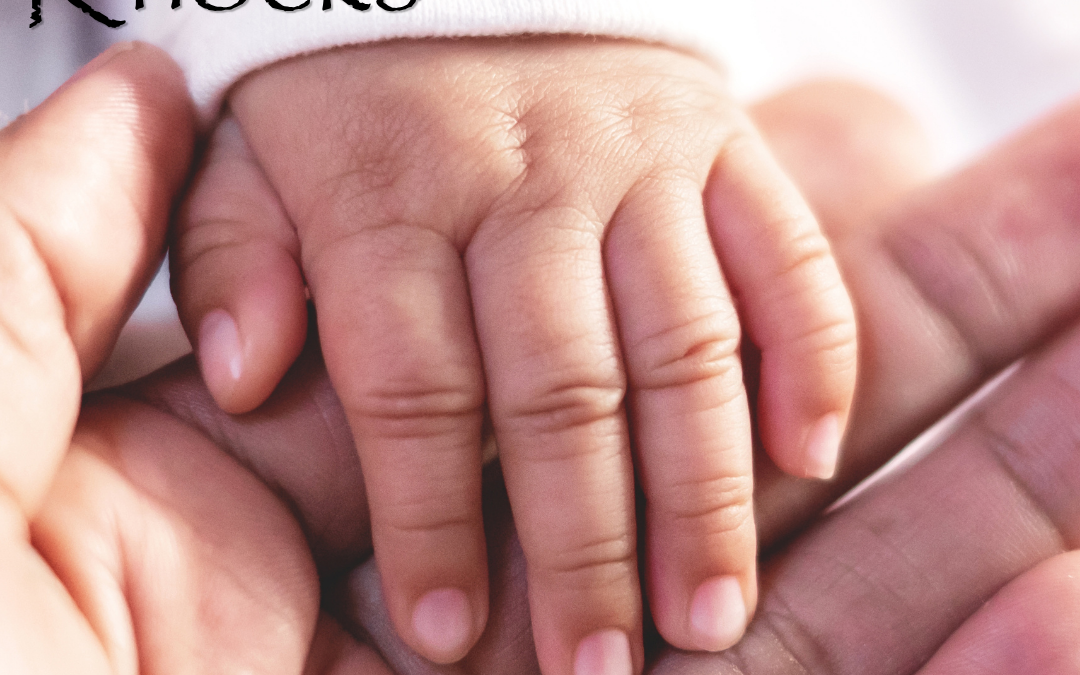
    Just me and the kid, alone in the room. My heart full of nostalgia for this precious babe, I breathe in the peace of the moment. I cannot wrap my head around the gift I have been given. I memorize his little nose; I caress his tiny hands; I am convinced that I am looking at a miracle. Exhaustion from the day’s events fully realized, I close my eyes for a moment—until a sharp screech slices the aura from across the room.

    Is he hungry? Does his diaper need changing? What do I do now?

    Suddenly, it is apparent that everything is going to be different.

    When Jesus disrupts the Festival of Tabernacles in John 7:37-39, he is speaking to a religious community that is clinging desperately to a providential view of God. They worshipped in search of fruitful harvests, healthy families, and a plentiful catch. But Jesus comes proclaiming that such transaction will never quench their thirst for a flourishing life.

    The people may be honoring God with word and action, but they have not experienced a change of heart to live fully in sync with God. Through disruption, Jesus introduces them to the Spirit.

    Disruption is actually a huge part of my life. I’m usually late to meetings because I cannot walk to my car without six people needing something. I have a reputation for sending late-night emails because the witching hours—after my family is asleep—are often the only time I can find in the day to put together an intelligent thought. People beep at me at stoplights because I’m often talking to the panhandler long past the point the light turns green.

    My son—now 14—also gets a dose of disruption every evening when we take long walks together. He has lots to tell me about his day, the fantasy worlds he is building, and the latest topic he has been Googling. But he’s growing accustomed to pausing his thought when we stop to visit with the unhoused friends we meet along the way.

    In its own way, the comfort I have developed with disruption is itself a disruption to others. But it is the people perceived as the most disruptive who have taught me the value of a good disruption.

    There are things in scripture I would have never considered without the chance to discuss them with unhoused neighbors in a Sunday morning Street Church service.  I wish the world could be a fly on the wall for the ways my differently-abled friends love God and one another.

    Forgiveness becomes transformative when extended to the same person 490 times. But it is even more powerful when you are on the receiving end of a neighbor who forgives the ways your own humanity stepped out of sync with the love of God.

    I’ve come to appreciate that the person who stops me in the parking lot or the call I get to check on someone is the farthest thing from a nuisance. It is simply the Holy Spirit keeping me in check.

    As a new mother, I knew that a child would add to my life, both in responsibility and joy. Naïvely, I imagined that addition would settle on top of everything that already was. Instead, it turned my world upside down.

    I didn’t know it at the time, but the earth shifted on the night my son was born. All the things I thought I was were jostled loose from the comfortable shelves in my heart; the aftershocks thereafter would profoundly reshape my existence in the world. 

    God continues to move that furniture around in the living room of my soul. The drapes are adjusted about every week, and the paint colors might change at least once a month. There was a time these things would bring so much dread—enough to cower in the corner under a blanket until the interior decorator had left. In recent years, I race to the door with excitement.

    I know, when disruption comes knocking, the Spirit is on the move.

    – Dr. Meghann Cotter
    Executive Servant-Leader
    Micah Ecumenical Ministries

  • Every Human Hungers for Connection

    Every Human Hungers for Connection

    In a book called Beyond Homelessness, Theologians Brian Walsh and Stephen Bouma Prediger tell the story of two men: Kenny and Kenneth.

    They are neighbors, but seemingly, they do not have a lot in common.

    Kenneth is successful—he has a corporate job, travels between cities, and he owns multiple homes. 

    Kenny lives under a bridge and panhandles for survival.

    Kenneth has power, influence, resources—but he does not know his neighbors. His life is full of movement, but empty of connection.

    Kenny, for all his instability, is known. He has people, even if most of them live on the street with him. He has places where he is expected. Even if it is the outreach center where he helps prepare meals, he belongs.

    The question the authors ask is: “Who is really homeless here?” And the answer is both of them, albeit in different ways.

    Kenny’s homelessness is visible. Kenneth’s is hidden—social, emotional, even spiritual. But the experience of displacement is real for both.

    And this is not the world God intends.

    Brian Walsh puts it this way: “We live in the tension of being rooted and uprooted… homebreakers, even when we long to be homemakers.”

    Scripture affirms that humanity was created for home—living in right relationship with God, one another and creation. The original “garden” home came with a purpose—caring for one another’s flourishing.

    That home was fractured. But God’s intentions never changed. God goes with humanity into its homelessness—to the wilderness and into exile—drawing near through prophets, kings, and ultimately Jesus, who comes to dwell among us.

    Then, in Acts 2: 42-47, we catch a glimpse of what life can look like when God comes to dwell with people once again—a community is restored, life is shared, and no one is left in need.

    Today, the deepest divide between unhoused neighbors and the rest of us is not money and social problems. It is the loss of relationship—the breaking of connection that leaves people unseen, unknown and alone.

    And the question that follows is this: How might we pursue them with the same goodness and mercy with which God has pursued all of us?

    At the most basic level, all of us need four things: Somewhere to live, something to do, someone to love and something to hope for. Those things come more easily for some than for others. 

    Our unhoused neighbors are carrying more than we can see. At least 78% are living with one or more disabilities—mental health challenges, physical limitations, learning differences that have shaped their lives from a young age. 

    Their stories are never simple. Relationships have broken down in their lives—not only because of personal choices, but also because of family instability and systems that are often difficult to navigate. The death of parents is catastrophic for some people. Some come from families without resources to support them.  Sometimes, the streets are safer than the home they left behind.

    Across the country—and here in our own community—the two fastest growing groups of unhoused neighbors are between the ages of 18 and 24 and older adults over 60. If you think about the times in our lives we most need relationships, it is when we are learning to be an adult and when we get old.

    Our unhoused neighbors are people whose connections have unraveled—and they need community. Not just housing. Not just services. Like all of us, they need a place to live, a reason to rise each day, relationships that are real and a reason to hope again.

    Acts 2 was never meant to be a moment. It was meant to be lived out—a community shaped by God’s pursuit of us, so that we might pursue one another.

    – Meghann Cotter
    Executive Servant-Leader
    Micah Ecumenical Ministries

  • A Snowstorm and the Road to Damascus

    A Snowstorm and the Road to Damascus

    Fredericksburg had frozen over.

    Where accumulation underperformed, the thickness of Jack Frost’s blast had accommodated.

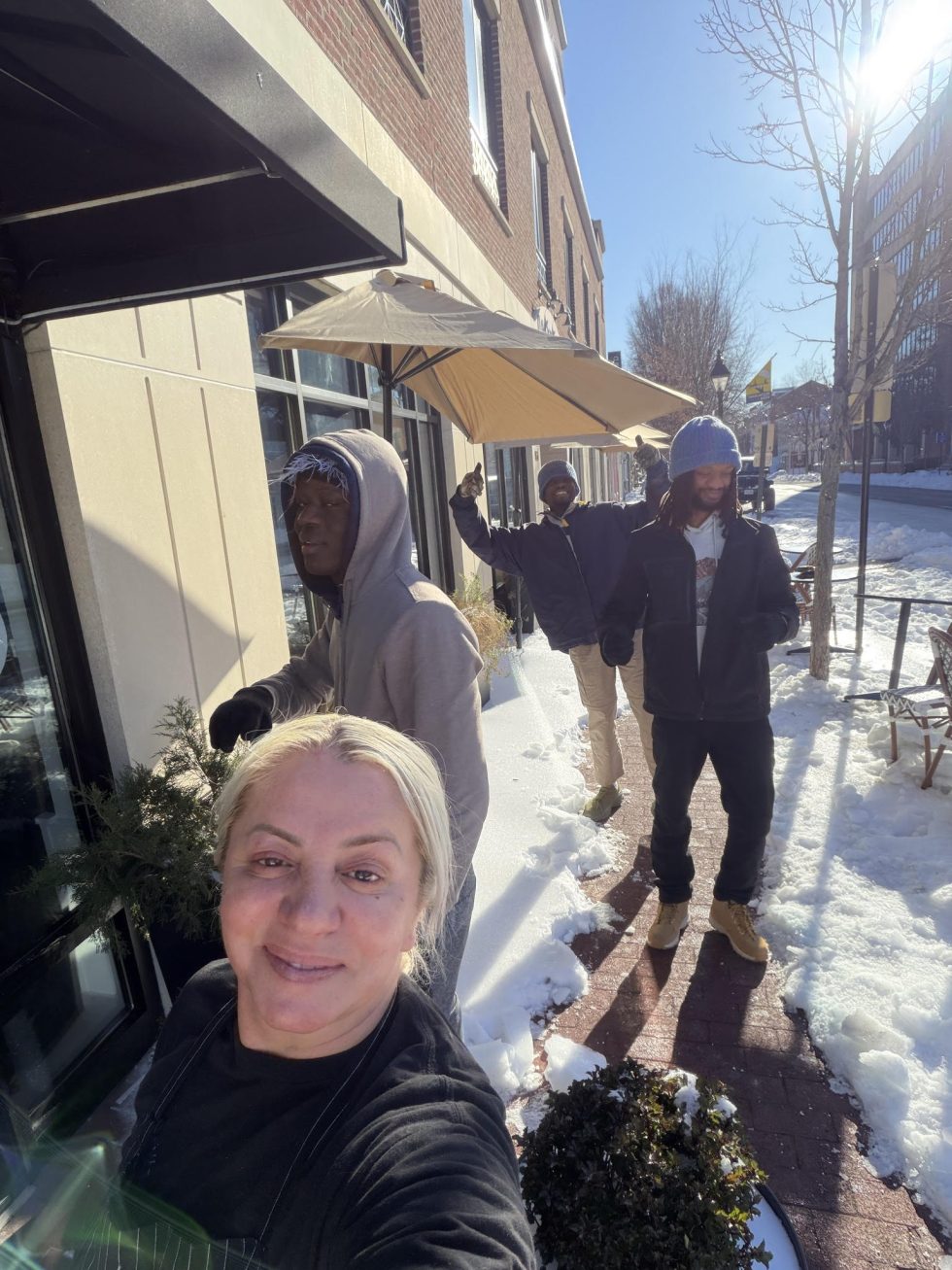
    In typical snow day tradition, members of the Micah community were clamoring for shovels at the first sign of flakes. Where snow signals hot cocoa and jammies, days off from school and an excuse to stay off the roads for many of us; snow, when you live with your back against the ground means “money.”

    Our unhoused neighbors might struggle to find steady work, but boy can they seize a snowstorm for a solid day’s earnings. 

    I’ve been so impressed with what our neighbors accomplish on previous snow days, that this year I decided to try something different. Within moments of posting in a downtown business owners’ Facebook page, my phone started pinging.

    “How much?”

    “How soon can they get there?”

    “My address is…..Please help.”

    Business after business, some snowed in outside of town and others not physically able to chip the ice off their walk, sought relief. 

    This time, our unhoused neighbors were not the problem. They were the solution.

    I’m grateful that our neighbors—sleeping on the floor of the Baptist Church at the time—were able to make money.  I am grateful, at a time when the snowplows were struggling, the Micah community could show up for our city as good neighbors.

    But my favorite part of the story is how, for a moment, the roles between unhoused neighbors and business owners shifted—and both began to see each other differently.  

    In Acts 9, there was a man who was absolutely convinced he knew everything there was to know about early followers of Jesus.

    As a devout Jew, Saul’s life centered on law as the way to have a relationship with God. Everything about Christ followers, who called themselves “The Way,” conflicted.  They were making dangerous claims—that Jesus was Lord, that grace was available to all, and belonging was no longer defined by the authority of the religious system.

    The people of “The Way” lived differently. They gathered outside the temple. They welcomed people the priests would have kept at a distance. And they trusted grace where any good Pharisee would have demanded certainty.

    In Saul’s mind this was not just a disagreement.

    It was a threat. A threat to the faith he loved. A threat to the order that held his world together.

    So, he did what made sense to him.

    With the backing of religious authority, he set out to stop it—tracking down those who followed Jesus, dragging them from their homes and bringing them back in chains.

    Saul was certain he could see clearly; and that certainty…is exactly what made him dangerous.

    The best part of the story, however, is how the roles between Saul and those he wanted out of the way shifted—and both began to see each other differently.

    The good news of this story is not that Saul finally figured it out—it’s that Christ came to him while he was still wrong.

    On a road, through an encounter, and into a calling, God interrupted Saul’s life… and profoundly reshaped it.

    The Road

    As Saul walks along the dusty Damascus Road, his sin is not what he is doing wrong—it’s that he is unable to see the ways that God is at work without him. His mission is not interrupted in a synagogue, a worship service or theological debate. He is in the middle of nowhere—far from the high priests, the structures that gave him confidence, far from the comforts of being right.

    And especially there, Saul doesn’t choose Jesus.
    Jesus confronts Saul.

    Saul thinks he is advancing the flourishing of the world by getting rid of people, but they are the ones with whom Christ identifies most closely. There is a blinding light, a voice, and Jesus says, “Saul, Saul, why do you persecute ME?” Not my people, not my followers—Me. Jesus equates Saul’s actions to a direct assault against himself.

    In that moment, all the things Saul thought he saw clearly—his certainty—collapsed.

    And yet, God does not destroy Saul. God claims him.

    Because grace does not wait for us in certainty—it meets us in the middle of things, and interrupts. 

    The Encounter

    Blinded, Saul—the powerful crusader—becomes completely dependent. He is led by the hand. He cannot see. He cannot eat. He becomes vulnerable to the very people he once pursued.

    But notice—

    Saul’s blindness is not where he finally figures things out. It is where God begins to remake him.

    In darkness, Saul is stripped of control and brought to a place of vulnerability. He must unlearn what it is to be certain to assume a position to receive.

    Because grace doesn’t begin when we understand—it begins when we are finally brought to the end of ourselves.

    The Calling

    Saul would have had no use for Ananias—until he needed him. Without God’s urging, Ananias would have avoided the man from Tarsus who was persecuting disciples such as himself. But when the one who was feared became the one who was afraid, and the one who was afraid crossed the lines of fear, God reshaped relationship in the form of the cross—and enemy became “brother.”

    Two callings are fulfilled that day.

    Ananias does not go because Saul has proven himself safe. He goes because God has spoken. In his obedience, Ananias becomes the means through which Saul can become the instrument God is calling him to be.

    But there is a moment of hesitation.

    “Lord…I have heard about this man.”

    Of course he has.

    How could God be calling him to go to a man who has caused so much harm? Surely, Saul does not deserve it. Ananias is certainly not ready. But God is already at work.

    Because grace doesn’t wait for us to be ready—it meets us when we are still afraid.

    Saul’s life changes on the road, but it becomes whole when Ananias walks through a door he would rather avoid. Ananias’ life changes when God instructs him to “Go,” but it becomes whole when he enters “enemy” territory and becomes part of another’s healing.

    And maybe that’s where this story meets us. Not in being Saul, but in being people willing to go, even when we are unsure, even when we are afraid, trusting that God’s grace goes before us.

    Snowstorms are not the first, nor will they be the last disruption our community experiences, as God works through unhoused neighbors to enrich our lives and peels the scales from all the certainties we think we have about the world.

    With God’s help, unhoused neighbors have been our teachers, the community that once dismissed them showed up nearly a thousand strong for the Coldest Night of the Year walk, and you may have heard…this mustard seed of an idea has now morphed into plans for a supportive housing neighborhood—a permanent home for our neighbors in Jeremiah Community.

    Jeremiah Community will be a place where our neighbors can live affordably and grow meaningful relationships. But you know what I can’t wait for? The ways this home for our neighbors will encourage purpose.  Answering the phone, being part of the grounds crew, running the laundry room, working in the kitchen, driving the golf cart, and so much more, are ways the people who live in Jeremiah Community can live into the fullness of who God called them to be.

    And maybe that’s the deeper gift—not just that we are building a home for our neighbors…but that God is building something in us.

    Teaching us to see differently. To receive from one another. To call one another “brother”… “sister”… and mean it.

    When that happens—the scales don’t just fall from Saul’s eyes…they fall from ours, as well.

    – Meghann Cotter
    Executive Servant-Leader
    Micah Ecumenical Ministries

  • Bearing Each Others’ Burdens Builds Capacity for Hope

    Bearing Each Others’ Burdens Builds Capacity for Hope

    I had needed to visit Robbie for several weeks.

    When he moved from Micah’s respite house to a nursing home, I had promised he would not be forgotten. But in the busyness of leading a young non-profit, raising money and learning the many things I had to learn about caring for unhoused neighbors, time had gotten away from me. I needed to go. I thought about it daily; and most importantly, I had promised him a pint of Chunky Monkey ice cream when I came.

    The day came when I had made plans to visit Robbie. I stopped at the store, had the ice cream in tow, and my phone rang. The priest from the Catholic church, where I later learned that Robbie’s family worshipped, was calling to tell me that he had died.

    Tears immediately fell from my eyes. “I promised to bring him Chunky Monkey ice cream,” I cried. “And I was on my way.”

    “You can still take it,” the priest replied, and he hung up the phone.

    When I arrived in Robbie’s room he was still cold in the bed. A small, gentle woman about my height introduced herself as his mother. The young, well-put together man who sat at Robbie’s bed side, she said, was his brother.

    I had no words. I had obviously been crying, and all I could squeak out was, “I’m so sorry, I know I’m late; but Robbie had asked me to bring him Chunky Monkey ice cream.”

    And we all cried some more.

    I knew of Robbie’s family; but I had never met them. It was at his death bed that I learned of the years he had struggled with mental illness and addiction. They tried to help. They wanted to help. They did what they could to help.

    “I know you only knew my son for a little while,” she told me that day. “But I have had more hope for my son these last few months, than I have had in years.”

    I wondered how a mother who had struggled so long and now lost her son could express hope in his untimely death. “He did not leave us,” she said, “without knowing he was loved.”

    I don’t believe it is a coincidence that the man brought back from the dead in John 11 and the poor, homeless, beggar who sat at the rich man’s gate, in Luke 16, have the same name. Lazarus means “God has helped.”

    You may recall from the Luke story that a man who had been discarded by society discovered new life in heaven. The man who had everything? He lost it all in eternity.

    While far too late for the rich man, his fate brought new perspective on the ways he and his still-living brothers lived their lives. His flourishing in the absence of others’ flourishing may have been comfortable; but spiritually they were the walking dead. 

    Only in death does the rich man, who ignored Lazarus in his lifetime, find a use for him. He pleads with God to resurrect Lazarus and send him as a messenger to warn his brothers.

    A resurrection changes nothing, God tells him, if the people who witness it cannot believe.

    By contrast, let’s talk about the faith of Mary and Martha in John 11. The sisters send word that their brother is very ill in Bethany. Jesus loved Lazarus, but he did not leave immediately. And by the time he arrived, Lazarus has been dead for four days. To complicate matters, Bethany is a dangerous place for Jesus. He has already made people in power uncomfortable. There was a plot to silence him with arrest and crucifixion; and Bethany was the last place the Jews tried to stone Jesus. It is so dangerous that the disciples first resist the trip. Then they concede, accepting that the journey may result in their own deaths.

    The urgency of Mary and Martha’s message is as much out of love for Lazarus as it is their belief that Jesus’ connection to God is so great, it is worth the risk.

    By introducing Mary as the one who anointed the Lord with perfume and wiped his feet with her hair, the passage foreshadows the different ways the two sisters will worship Jesus after Lazarus’s resurrection. The ways they wait for Jesus’ arrival after Lazarus’ death also reveal the different ways the women grieve.

    Martha takes action, meeting Jesus at the edge of the village. She is upright, direct and prophetic about how God will move as Jesus shares their suffering. 

    Mary is consoled at home by other Jews. She comes quickly; but Martha has to go and get her. She speaks to Jesus from her knees. She brings a crowd of others in mourning.

    The water falling from their eyes was so overwhelming, the passage says Jesus was both disturbed and moved. Moved for the love their tears express. Disturbed, perhaps, in how they suggest he is too late for the miracle they had hoped.

    The sisters’ words to Jesus are not dissimilar. “Lord, if you had been here my brother would not have died.” There is no disagreement that the sisters believe Jesus is a catalyst for God’s power over death.

    While Martha does something about her belief, Mary sits with it; and her belief is strengthened as she witnesses her brother’s resurrection.

    Through Lazarus, God helps both of them draw closer to God and one another.

    The raising of Lazarus was not just a literal activity—it was a counter-cultural expression of a God that redefines our suffering. Before Christ, suffering was an outcome. Not only did Christ make it possible for God to share our suffering; he also gave us someone who showed us how to bear the burdens of one another. As Paul says to the Romans:

    If we think we can prevent suffering, we will be frustrated.

    If we think we can fix suffering, we will be disappointed.

    But if we embrace suffering, we join God in what God is already doing in the world. Even if it takes a long time to get there…the Spirit moves and hope prevails. 

    I recently read about a ministry called Open Door in Atlanta. Every year during Holy Week, they have a tradition called “via dolorosa of the homeless poor.” It involves spending a week on the streets, in 24-hour blocks, alongside unhoused neighbors in their community. The practice began in the 1980s in a year when Palm Sunday fell immediately after the closing of most shelters in Atlanta. The experience gives the housed community an embodied understanding of homelessness and increases their capacity for lament.

    Similarly to the via dolorosa—the way of sorrow—that Jesus walked, the founder of this practice, Murphy Davis says, “homelessness is like a slow execution, [since] the monotony of the day, the exhaustion, the punishment your body takes from the weather, the lack of healthy food, the slavery of labor pools—all lead to death.”

    Our community’s winter shelter closed for the season this past Friday. It was also the birthday and funeral date for Mike, a man whom Micah cared for many years.

    His daughter, her mother and the man’s two grandchildren joined the Micah community at city dock to remember him and scatter his ashes.

    We remembered how he liked to dance. That he convinced his case manager to give country music a try. How he worked with Tree Fredericksburg for a good while, planting trees and beautifying our city. The gift he had for woodworking, and that he handmade a baby crib for his daughter when she was born. The recent years, when he finally made peace with himself, his apartment, and his family.

    This was a man who had been to jail so many times that society had given up on him. No landlord would rent to him. No employer would give him a job. He was very much alive the many years we cared for him; but his personal sufferings had deprived him of the same right to exist.

    But in that Friday moment at City Dock, life was breathed into all the ways this community joined God to set Mike free from the tomb the world had put him in.

    Mike’s 7-year-old granddaughter walked to her mother’s side as the ashes were sprinkled into the river. With a little encouragement she reached her hand into the bag and grasped a fist full of ashes. She opened her hand on that windy afternoon, and the wind carried them away into the water.

    When they were gone, she promptly brushed her hand across the front of her pants leg, leaving a perfect handprint.

    “Look, your grandpa’s fingerprints are all over you,” said someone gathered there.

    Indeed, Mike had left his fingerprints on all of us, as have the hundreds of other unhoused neighbors who have gone before him. Their stories are painful, sometimes devastating and often hopeless. But sharing in their lament, prepares us to receive the Lord.

    Perhaps, the miracle in God’s story was not that a man rose from the dead. It was that the people believed when they had no reason to do so.

    It’s never too late for a miracle. And resurrection changes everything, when the people who witness it believe.

    – Meghann Cotter
    Executive Servant-Leader
    Micah Ecumenical Ministries

  • The Miracle Nobody Noticed

    The Miracle Nobody Noticed

    My first apartment was in downtown Fredericksburg.

    On a daily basis, especially when it was warm out, many people would walk up my street to access the nearby Canal Path.

    It was not until I began volunteering at a community dinner, hosted by a downtown church, that I noticed one particular man who walked by nearly every day, even when it was cold outside.

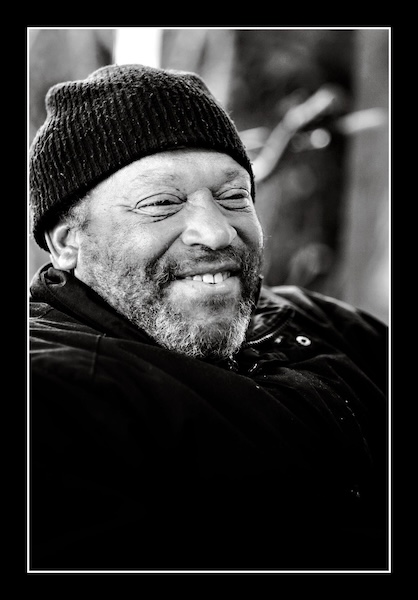
    Lamont was a big burly guy. He didn’t carry a lot with him, but the one bag he did have was often overloaded, dirty, and torn, but patched back together in places. His shoes were often mismatched, and he wore them without laces. I would later learn he did that because his shoes didn’t fit, and laces kept him from stretching them out to accommodate his feet.

    As I got to know him, he would stop to talk to me when I was working in my yard. He had some interesting ideas about spacecraft, where he was headed and what kind of jobs he could get. I enjoyed talking to him, but I remained troubled that I had never noticed him before I started serving meals.

    I was sure his walking pattern was not new.

    I was sure he had passed by my house for many months prior.

    But my eyes had never engaged him the same way they did the joggers, people walking their dogs, or parents out bike riding with their kids.

    I had not noticed him; nor had I noticed what other people were seeing.  

    He talked to himself and sometimes sang. He had some wild stories, and his telling of them was usually hard to follow. Relationship opened my eyes to his many struggles; but it also revealed the judgment of others.

    “It’s terrible what some people do to themselves,” one man said, implying that he had fried his brain with drugs.

    “What do you think he did that his family no longer wants him?” or “Can you believe a family would let someone live that way?” asked others.

    None of those asking questions had taken the time to know the man’s circumstances or even his name; and yet, the only thing they noticed was that he was a disruption.

    These are the moments I wonder if we have learned anything since Jesus walked among us. Just as the disciples once probed what personal or parental sin caused a man’s lifelong blindness (John 9:1-41), society still evaluates human worthiness as individual or familial failure. Rarely do we turn the inquisition on ourselves.

    As Jesus teaches the disciples, disability, vulnerability, circumstantial concerns are not a result of sin or failure; but that “the works of God may be revealed.” 

    How might our world be different, if all the assumptions about our differently-abled neighbors became a curiosity for what God is doing?

    Instead of assuming our neighbors in tents must not want housing, we might reconsider how policies, resources and systems in our control could ensure that no one had to live outside.

    For those still resistant, we could seek to understand what environmental design would work for them—tiny houses, detached walls, rooming houses, who knows what we could come up with.

    Rather than wondering how someone who struggles has burnt bridges with all the people who should love them, we could invest energy in how we love them.

    Instead of assuming their parents dropped the ball, we could have a hard conversation with ourselves about the wide wilderness that exists between familial capabilities, personal limitations and the expectations of public systems; and we could work to bridge the gap.

    I’m still mesmerized how many people do not know or have not shared my awe for what happened with our unhoused neighbors during the pandemic. For two and a half years, there were enough emergency resources coming into our community that no one had to sleep outside. There were just two people that outright refused to accept a room; and we worked to accommodate them otherwise.

    For a moment in our community’s history, we functionally ended homelessness; but there was no rejoicing, no motivation to keep the movement going, and very little media coverage that we did not create ourselves.

    As a street outreach ministry for most of our existence, Micah had a lot to learn about sheltering people. One of the most important lessons was how much easier it was to care for people—even those with complex mental and physical disabilities—when they were settled in a hotel room vs. surviving the elements.

    We also proved that most people who live outside would accept accommodations if the environment was not triggering. Many of our neighbors reject congregate spaces, including the cold weather shelter, because they have been over-institutionalized in jails and hospitals. They cannot handle close quarters, lots of people or conflicting personalities.

    The benefits of pandemic hotels made it possible for more exits to permanent housing than we had ever seen.  But time and resources were not on our side to ensure everyone we had sheltered could exit to permanent housing. 

    As the pandemic evaporated, some people returned to the street. Part of me hoped it would jolt the attention of people with power and influence, that it would prompt a response for hotel sheltering to become a new normal.

    The return of visible homelessness in our community did grab people’s attention, but not in the ways we hoped.

    We were begging people to see the possibilities, to recognize the incredible thing that happened and their power to keep it going. The community assumed homelessness had suddenly exploded, when in fact the only thing they were noticing was that they had not noticed the miracle that had occurred while everyone was sheltering in place.

    The questions we lived in before the pandemic returned: “How could we help get people out of the way?”

    I’m told it was just bad timing for a miracle. Local governments and other people in power were preoccupied by too many other things. It was hard to find the bandwidth for something new.

    But the works of God have not ceased to be revealed in the sick and vulnerable among us.

    Though we have been blind, we now see what is possible. And with great sight comes great responsibility. Maybe our lenses need adjusting. Perhaps we need bifocals or cataract surgery; but the call remains: drawing closer to God through proximity to one another.

    – Meghann Cotter
    Executive Servant-Leader
    Micah Ecumenical Ministries
  • The Prodigal Returns: Love your Neighbor Close to Home

    The old man had an attitude before I even showed up. By the time he got in my car, he had more than choice words for me and everyone else he would encounter that morning.

    I should set my alarm earlier.

    His place to live had problems.

    And if it weren’t for me, maybe his knee wouldn’t hurt so much.

    We walked into Street Church with plenty of time to eat breakfast before worship. But breakfast that morning was muffins and donuts vs. the pancakes and bacon he had been hoping for. That was my fault too.

    The busy gathering of neighbors, fresh off the cold weather shelter bus was noisy that morning as we began our Christmas worship service. And the Lord was not with my friend as he screamed obscenities to quiet the room. If only I had “higher standards” for the kinds of people I let in there on Sunday mornings, we wouldn’t have such problems!

    On the way home, I made sure my friend was last to be dropped off. And then, I leveled with him.

    “What’s really going on,” I asked. “Is there anything you really want to talk about?”

     “Here it is Christmas and my own family won’t call me,” he exclaimed. “I always have to be the one to reach out. They don’t want anything to do with me.”

    “Have you called them?” I asked.

    “NO!” he fumed.

    “Do you talk to them like you have been talking to me this morning?” I asked; and for the first time that morning, he was silent.

    “I have a suggestion, if you’d like to hear it,” I said quietly. He shot me a glare out of the side of his eye.

    “Why don’t you try calling and, even if you get their voicemail, maybe say something like: ‘Merry Christmas. I love you. That’s all’.” As I looked over, big pools of tears welled up in his eyes. He fought to maintain the gruff persona he had carried all morning, but he melted quickly right there in my passenger seat.

    “Want to try saying it?” I asked.

    Tears streamed down his face at this point, but after a few moments he choked out the words, “Merry Christmas. I love you. That’s all.”

    I have received many a desperate call over the years from a family member who had run out of ideas for helping their loved one. Be it a child, a sibling, a parent or spouse of someone facing homelessness, the struggle is real for families where no amount of resources, expertise or love leads to a solution.

    Sometimes, Micah has been able to team up with families, building the bridge between organic care of blood relationships and societal systems that seem impossible to access. More often, the work centers on the individual. As people gain stability and improve their financial situation, they naturally address other aspects of their well-being; and it becomes easier to rekindle relationships. Until then—and it can be a long “then”—the yearning of current and formerly unhoused neighbor to belong to a family unit can be devastating if not debilitating.

    Unfortunately, I’ve had to make enough next of kin calls after a neighbor’s passing to know the desire for reconnection is not lost on families of those who experience homelessness. The calls usually come with a story or two, painful memories and joyful ones, and a variety of statements, like:

    “I haven’t heard from him in more than a decade.”

    “I really didn’t know how to help her.”

    “I did love him. I hope he knew that.”

    As much as I believe that neighbors become homeless when they run out of relationship, these conversations are reassurance that dislocation from community of origin never replaces humanity’s inherent belonging to one another.

    It is tempting to judge either family or neighbor for the things that separate them. Why can’t people make better choices? How could someone let a family member become homeless? But compassion asks different questions.

    Consider the story of the prodigal son (Luke 15:11-32).

    How hard must it have been for the father to let his son try life his own way? And the son who thought an inheritance was all he needed to stand on his own two feet. How much courage must it have taken for him to swallow his pride on an empty stomach and return to his father, with no expectation of familial status than a household servant? How must the father’s heart have broken all over again when the older brother could not share joy for the younger’s homecoming?

    “Do you realize, then, what Jesus is teaching?” writes Timothy Keller. “Neither son loved the father for himself. They both were using the father for their own self-centered ends rather than loving, enjoying, and serving him for his own sake. This means that you can rebel against God and be alienated from him either by breaking his rules or by keeping all of them diligently.”

    Regardless of our response, God the father cares deeply about all things lost and eagerly awaits the homecoming.

    As for my friend, he could stay mad about the ways he remained disconnected; or a simple phone call could move him that much closer to reconnection.   I could get in my feelings about the man’s attitude that Christmas. I could blame his family for not returning his phone calls. Or I can explain once more how desperately God needs all of us wants the world to be one again.

    But its far more complicated than that. So, I’ll keep trying and start with this:

    Merry Christmas. I love you. That’s all.

    – Meghann Cotter
    Executive Servant-Leader
    Micah Ministries

  • Zacchaeus is Listening: Love your Neighbor Close to Home

    His small heart grew three sizes that day. Then the true meaning of Christmas came through; and Zacchaeus… I mean the Grinch… found the strength of ten Grinches plus two.

    It isn’t Dr. Suess.

    It’s the story of a man who had taken everything from the townspeople, and how he was transformed by an encounter with the original “Christ”mas.

    It is hard for me, at times, to remember that Jesus held just as much concern for the wealthy and powerful in relationship with God as he did the poor and down-trodden. Although Zacchaeus (Luke 19:1-10), the tax collector, leads very different life from those he takes advantage of, his personal suffering is not dissimilar.

    He finds himself under-resourced to access what he wants. Why else would Zacchaeus go out of his way to get a glimpse of the rumored Messiah as he simply passed through his town? Arguably, his sprint ahead of the crowd and climbing of the tree was a break in character from the stature he was accustomed.

    Zacchaeus did not go seeking Jesus. Jesus found him where he was. No different than the blind man, the leper, or the possessed man in the cave, Zacchaeus is one more hurting person in Jesus’ path who has fallen out of community.

    Popular opinion was appalled that Jesus would spend time with Zacchaeus. But Jesus knew that bringing about the kingdom was not an exclusive invitation. The poor often need to be invited into the home God intended for humanity, but the fact that Zacchaeus had one did not make him any less lost.  So, Jesus invites himself to become a part of what Zacchaeus already had.

    In one of his beloved books, Theologian Henri Nouwen writes, “Nobody says we should love the rich less than we love the poor. The poor are indeed held in the heart of God. We need to remember that the rich are held there too…More and more, my experience is that rich people are also poor, but in other ways.”

    Christmas came to Whoville without ribbons and tags. It came without packages, boxes and bags. The Grinch had taken the Whos material representations of Christmas; but it did not change who they were.

    “Welcome Christmas, come this way. Welcome Christmas, Christmas Day,” the Whos sang that empty Christmas morning. And it became an invitation for the Grinch to experience the world a little differently.

    “Christmas Day is in our grasp. So long as we have hands to clasp,” they sang and were joyful without presents at all. Not only did it cause the Grinch a change of heart, he brought everything back and joined the Whos in a Chrismas feast, in which he himself carved the roast beast!

    With Jesus’s invitation extended, Zacchaeus too becomes part of a new communion; and as a result, he chooses to participate in community differently.

    No matter how far apart we find ourselves in economic status, social standing, religious values, or other things that divide us, we cannot underestimate that those who experience the world differently than us may very well be listening when we least expect it.

    Our God is a God of many truths.

    It is true that homelessness effects public safety, economic development and community aesthetic. It is also true that communities across the country lack affordable housing, supportive services capacity and systemic solutions for individuals who live outside to have alternatives.

    It is true that people should not break the law to live in the United States. It is also true that our country has contributed to political and economic instability in other countries without offering reparations or a viable path for immigration.

    It is true that families, churches and neighborhoods should function as organic support for troubled youth, people with disabilities, young mothers and aging adults. We should not need the government to prop up social systems to ensure that all are fed, housed and cared for.

    It is also true that the bonds of relationship have weakened. We no longer know our neighbors, our social networks have been replaced by computers, and we have become the loneliest generation yet.

    It is true that God is unambiguously concerned with how the poor, the differently-abled, the refugee accesses a life that is flourishing. It is also true that the kingdom cannot come until the tax collector comes down from the tree and makes space in his home for love.

    – Meghann Cotter
    Executive Servant-Leader
    Micah Ecumenical Ministries
  • Lazarus is at our Gate: Love your Neighbor Close to Home

    A downtown business owner texted in a panic after encountering a young girl sleeping in a car near her shop.

    “I could not drive away without checking on her and introducing myself,” she wrote. “I just needed to tell you about her because I know its gonna start to get cold soon.”

    She proceeded to tell me the girl’s name and some of the things she had learned about her. I knew her, and I was able to assure the shop owner that help was in motion.

    Days later, while I was visiting the woman’s shop as a customer, she struck up a conversation with me about her experience.

    “Does it ever go away?” she asked. “That feeling like you want to do something but don’t know how to help.”

    If I am totally honest, I still have nightmares about homeless people after all these years. I worry about them like they are family. I can hardly have a conversation with one of them without imagining a scenario where they wouldn’t have to sleep outside.

    When my children were young, I would pop them in the stroller at bedtime and walk the downtown loop, where many of our neighbors bed down for the night. I often found it was a more peaceful time of the day to check in on people and connect with them as humans.

    At times I have joked, it was my way of tucking the family in for the night. Secretly, it also quelled my anxieties about who was sleeping where and what people needed.

    These days, I’m pulled in too many directions to maintain the habit; and, frankly, I’m tired. But on nights that my mind can’t settle down or in the early morning hours when I can’t go back to sleep, I still slip out for a long walk through our city.

    To further confess, my social/emotional location feels so broken sometimes that I struggle to relate to mainstream settings.  I cannot attend a holiday party without wondering what it would be to invest that glitz and glam and very heavy hor d’oeurves into solutions that get people off the street. I have a hard time sitting in church on Sunday without imagining the many ways those gigantic buildings could be useful to community needs. As my children watch the Christmas parade, I’m busy wondering what it would be for our current and formerly unhoused neighbors to have the opportunity to build a float.

    Does it ever go away? Not really. It gets worse the more the names and stories of neighbors on the street begin to mean something to you.

    But I cannot imagine it another way.

    For a long time, I thought that everyone saw what I saw. The wounded beggar named Lazarus (Luke 16:19-31) was suffering terribly in the heart of our city. He longed for the simple crumbs that would fuel his survival. Where it haunted me how much he blended into the scenery, he was haunted by how much other people wanted him to go away.

    Oh, how deep the chasm between the well-to-do and the not doing too well.

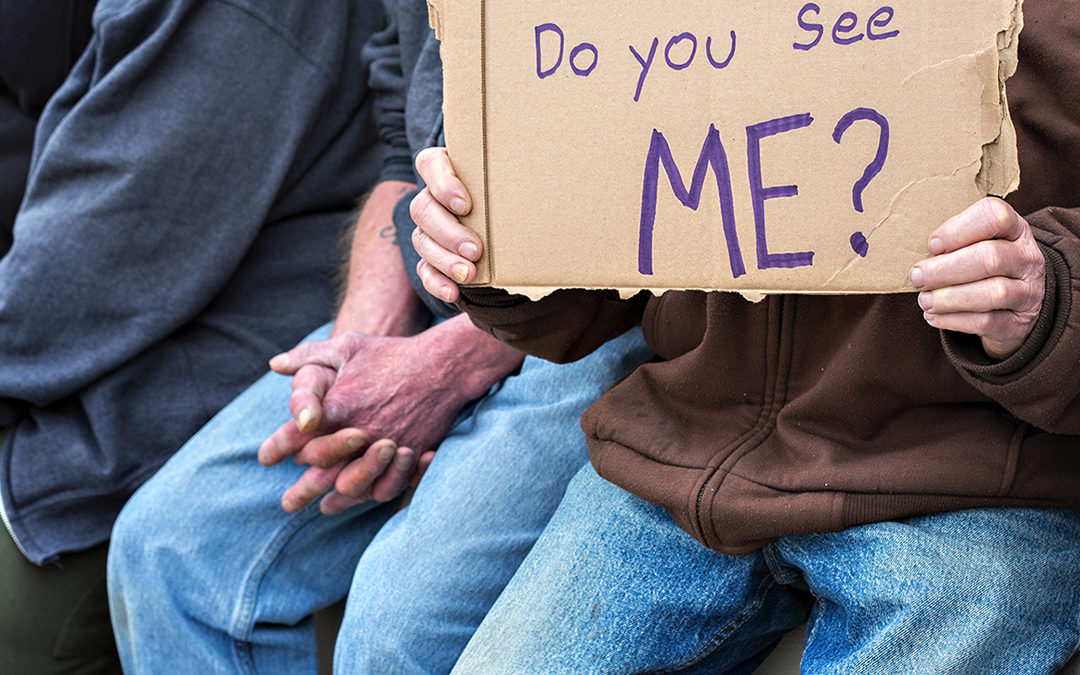
    An invisible line in the sand has created an entire “caste” system of those who “deserve” to be seen and those who can be discarded. The more elderly, the more differently-abled, the more affected by trauma a neighbor is, the less use society has for them.

    Yet, the chasm is so apparent to those who live on the invisible end of it, that even the thought of crossing brings about debilitating paralysis.

    In Luke’s parable, the rich man acknowledges the gravity of the situation only when he switches places with Lazarus in death. Condemned to torment, he experiences the immobility that Lazarus knew in life for the very first time.

    He summons for Lazarus to quench his thirst. His influence is gone.  

    Not even the wealth he had in life can buy his freedom to cross the chasm in death.

    The rich man begs Abraham to send warning to his family. But power means nothing in death if God’s story means nothing to those who are living.

    Does it ever go away? Well, if it does, we have lost our humanity.

    The shop owner kept me apprised of her connections with the young woman in her car throughout the coming days.

    “I gave her my card, some cash, and told her to come get her hair washed at the shop sometime,” she said. “I hope someone can do something to help her. Is there something I can do?”

    She already had.

    She noticed Lazarus at the gate and called her by name. And in that moment, the chasm between us all got that much smaller.

     – Meghann Cotter
    Executive Servant-Leader

  • This Advent Season: Love your Neighbor Close to Home

    Dear friend,

    There was a time in my life that I imagined God would call me across an ocean. I would become a missionary in sub-Saharan Africa, be imbedded as an investigative journalist in the Middle East, or build community with the Mayan Indians in South America.

    The tug on my heart grew stronger as a teenager, after hearing a woman speak about sharing God’s love in many different parts of the globe. I was mesmerized in ways that I did not understand; but I began to pray her prayer.

    God use me. Take my simple little life and let me go into places where no one else wants to go. I want to be your love, Lord, wherever people cannot see it and in whatever way you would have me be it.

    In my version of that prayer, I was praying for so many things; but it didn’t have anything to do with Fredericksburg, Virginia.

    Years later, as I explored the many places my calling could take root, the groans from the streets of my home community of Fredericksburg stopped me dead in my tracks. As Mother Teresa would say to all the many people who sought an opportunity to come work with her in India: “Calcuttas are everywhere, child. Go find yours.”

    Across the world, people live on two dollars a day. Here in the Fredericksburg region, 30,000 people live on less than $14,000 a year; and 1 in every 5 people spend more than 50% of their income on housing.

    Across the world, illness runs rampant and treatment is inaccessible. Here in Fredericksburg, 78% of people who live on our streets have a disability. Many have two or more.

    Across the world, climate change is affecting food sources; and 673 million people are hungry. Among them, one in every 10 people face food insecurity in the region we call home.

    How easy it is to be captivated by the world’s needs, that we miss the opportunity to build the kingdom here at home. We dismiss the ways God is at work in our own communities. And we resist God’s call to jump into the messiness that is right here in front of us.

    Lazarus is at our gate.

    Zacchaeus, the tax collector, is listening when he thinks nobody is noticing. He, too, can be transformed when the story hits home.

    The prodigal son may be lost, but his father awaits his homecoming.

    And there’s an expectant mother out there who has been displaced; and the room in the inn she is looking for might very well belong to you.

    These are the images of a God who desperately wants to dwell with humanity. And if we are to welcome God to our neighborhood, a good place to begin is right where we are.

    That is what our downtown churches set out to do through Micah Ministries 20 years ago.

    Across the country, it costs $35,000 a year in public safety, hospital costs and public services to keep one person living outside. Close to home, we care for people better and more cost effectively by moving people indoors and wrapping them with support. The approach has reduced chronic homelessness in our Fredericksburg region by 58% since 2010.

    Across the country, loneliness is the new epidemic in all socio-economic subgroups. Close to home, we know homelessness stems from a catastrophic loss of relationship. So, we deeply value the ways that volunteers come alongside and build community with our neighbors.

    Across the country, social safety nets are crumbling as the government questions its involvement in food, housing and health care. Close to home, our downtown churches have built a continuum of compassion through innovative interventions like:

    • We have our neighbors over for dinner in our church fellowship halls 365 days of the year.
    • Micah’s eight-bed respite house is now one of only 32 facilities in the country with national certification from the Health Care for the Homeless Council.
    • Income development doesn’t stop at public benefits. We nurture people’s gifts and move them into an economy of expanded purpose and income.
    • In two years of operating temporary accommodations at Hesed House, we’ve sustained a 73% exit rate to permanent housing.
    • We care for 170 people a year in housing; and now we are building a supportive neighborhood (www.jeremiahcommunity.org), which will catapult the region toward a community where no one has to sleep outside.

    In two decades, your love of hometown neighbors has evolved the Micah community from helping people survive on the street to caring for all parts of human flourishing. 

    One tangible way that you can help with the needs close to home right now is by giving to support our neighbors moving into housing. Just $128 will purchase a brand new mattress for one of our neighbors as they move in to their homes, but any amount helps.

    Neighbors who have been living in tents (and other places not meant for human habitation) for years often re-enter housing with a lot of trauma and very few belongings. Having a new mattress to sleep on, and a few new things that they like, is crucial to their healing process and long-term stability. Support us with your contribution by clicking on the donate link below. Excess funds raised above the current need for mattress purchases will be directed toward other housing stabilization costs.

    Please consider how your generosity this season can continue keeping care close to home—rooted in compassion, grounded in Fredericksburg, packed with belonging: one relationship at a time.

    Yours for the kingdom in Fredericksburg, as it is in heaven,

    Meghann Cotter
    Executive Servant-Leader
    Micah Ecumenical Ministries