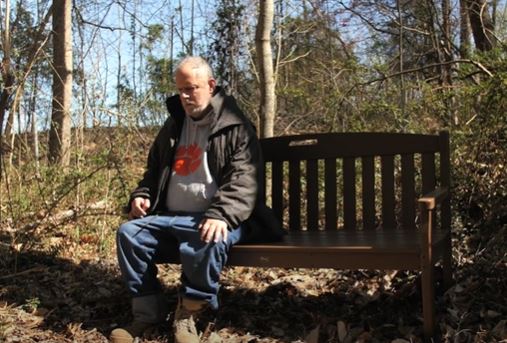
It was Christmas Eve of 2020, and downtown Fredericksburg was nearly silent.
I sat with Jeremiah beneath the Galleria overhang—the pavement he had called home for much of 27 years—and begged him to accept the apartment we had rented for him.
He quietly declined, as he had every other night since we took on a lease in September.
With unprecedented pandemic support, nearly every other unhoused neighbor we knew was indoors that winter. Jeremiah remained outside.
I handed him a cup of coffee and turned toward my car.
Maybe tomorrow, I thought.
It would be another two months of nightly visits before Jeremiah would finally say, “Yes.”
I cannot tell you everything that stood between Jeremiah and that eventual ‘yes.’ But I can tell you that having a place ready did not mean the journey into it was finished. There were more conversations to have. More time to spend together. More trust to build.
On the surface, this seems like a story of someone struggling to accept an invitation. A home was waiting. I kept asking. Jeremiah kept declining.
But what if the invitation had been coming the other way all along?
What if, through Jeremiah, God was inviting all of us to come closer? To make room in our lives as well as room in a house?
I was asking Jeremiah to leave the place he knew. What was I willing to leave? What assumptions, routines, and expectations would I have to surrender?
I could see how much accepting my invitation would change his life. But I was only beginning to understand how accepting God’s invitation would change ours.
In Matthew 22, Jesus tells religious leaders a parable about a wedding banquet. A king repeatedly summons the invited guests. Some return to their farms and businesses. Others kill his servants. And the king retaliates with terrible violence.
Then the invitation extends beyond the original guest list. The servants gather everyone they can find, both good and bad. Those expected at the celebration refuse to come. People who never expected to be invited fill the room.
Imagine hearing that as someone in a position of power, one that seemingly assures proximity to God. Jesus challenges the assumption that religious standing and a faithful response are actually the same thing.
Then the story turns again.
The king notices a guest without a wedding garment. The man has no answer and is thrown into darkness. Perhaps, the man’s presence does not reflect the celebration he has entered.
The challenge reaches those who refuse the invitation and those who accept it: Neither our standing nor our attendance can substitute for entering fully into the life God invites us to share.
That makes me wonder where we have placed ourselves in the story?
- Have we assumed we are delivering God’s invitation, without considering that we might be the guests too occupied to accept it?
- Have we expected someone’s life to change, without considering how profoundly it might change our own?
- Have we assumed we are there to offer others a place at the table, without considering that God is inviting us to wholly and completely sit beside them?
That brings me back to the overhang—and to the invitation I could not yet see.
I knew what I wanted Jeremiah to say, “yes” to. But how was God asking us to say, “yes?”
Jeremiah’s presence in downtown Fredericksburg had made him part of the scenery. Paintings of Fredericksburg streets occasionally include his quiet figure, as if he were a character in our local Where’s Waldo activity book.
Yet, many years after he had been housed, I would mention him only to receive blank stares and empty questions, “Who is Jeremiah?”
People had grown accustomed to him sleeping in a doorway. They had learned to walk around. Eventually, they stopped seeing him.
Some offered a little help. But rarely did the sentiment shift from, what is the city, the police or Micah doing about him…to what am I being invited into?
God’s invitation arrives through that recognition: Here is someone whose life belongs in relationship with yours, will you accept…
The guests who return to their farms and businesses have established lives, with responsibilities and priorities.
So do we.
But relationship means making room for someone whose life may interrupt those arrangements. I tell people all the time, when they start working at Micah, that this is so much more than a job. This is an invitation to move the furniture around in your heart—to confront the parts of yourself you don’t like; to allow our neighbors to bring out parts of your spirit that you would rather ignore.
Accepting the invitation to the kingdom does not mean we already know how to live it. It means we are willing to learn together.
I wanted Jeremiah to leave a familiar place. But I had to examine what had become familiar to me, too: my expectations about how quickly someone should accept help, what progress should look like, and when my responsibility would end.
The nightly visits asked me to practice patience when I wanted an answer. To listen when I wanted to persuade. To stay present when I couldn’t determine the outcome.
There is a difference between offering someone a seat and sitting down beside them; between offering a house and making a home.
When we sit together, we make ourselves available to receive as well as give. We discover someone’s humor, listen to their wisdom, and imagine a future shaped by their voices, too.
That invitation taking shape in the supportive housing neighborhood Micah is developing and, at least in part, why we are calling it Jeremiah Community.
The vision has grown from years of accompanying people into housing and learning what helps them remain at home. It makes room for permanent homes, ongoing care, shared spaces, and neighbors whose gifts will help shape the community.
It asks all of us to imagine belonging more fully to one another.
Under the overhang that Christmas Eve, I kept thinking, Maybe tomorrow.
Maybe tomorrow Jeremiah would say yes.
But Jeremiah’s “yes” began a succession of tomorrows.
Maybe tomorrow, we would understand why an apartment alone was not enough.
Maybe tomorrow, we would imagine a place where housing came with healthcare, purpose, belonging, and people who would not give up.
Maybe tomorrow, we would find the land, secure the approvals, raise the money, and bring together the churches, builders, businesses, students, and neighbors needed to build it.
Would we keep coming closer? Would we make room? Would we accept the invitation to be changed?
For years, tomorrow existed only in drawings, plans, and stories.
Then hundreds of hands raised the walls of the Jeremiah Community prototype last month.
Suddenly, tomorrow had a front porch. It had windows, a floor beneath our feet, and a door we could open.
And now, that door opens onto a question for all of us: What will we say yes to?
A first conversation? Returning when a relationship becomes difficult? Sharing resources? Discovering what someone else has to offer us?
That Christmas Eve, I thought I was waiting for Jeremiah’s answer.
Now I wonder how much of that time God was also waiting for ours.
The invitation is still before us.
Will we notice it?
Will we accept the life it asks us to enter?
Will we share that life with others God has invited?
For years, I walked away from that overhang thinking, Maybe tomorrow.
Today, we can take another step toward one another.
Dr. Meghann Cotter
Executive Servant-Leader
Micah Ecumenical Ministries
With the progress made, site work for Jeremiah Community will begin this Fall, and home construction will start in Spring 2027. We pray your involvement will make it possible for the first residents to move in by Christmas next year. Learn more and make your contribution here.